Date: Sat, 16 May 2015 02:52:22 +0000
Hi All
yes we are looking at a molecule with chemical but not magnetic equivalence.
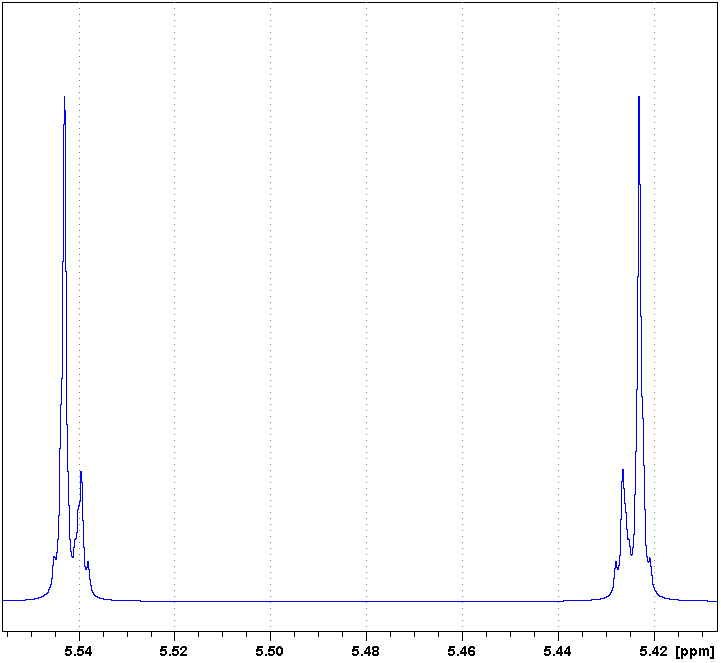
The spin system would be a A2A2'XX'. The one bond HN coupling should be around 90 Hz. The 3 bond is probably just a few Hz.
Plus there are couplings over 4 bonds between the protons and two bonds between the nitrogens. Attached is a simulation with a 1J(H,N) of 83 Hz,
3J(H,N) of 1Hz, 4J(H,H) of 1 Hz and 2J(N,N) of 3 Hz. Not a perfect match but close.
Clemens
On 5/15/2015 2:16 PM, Barchi, Joseph (NIH/NCI) [E] wrote:
Were my thoughts also….
J
From: Alan Brown [mailto:abrown_at_fit.edu]
Sent: Thursday, May 14, 2015 8:49 PM
To: Zhang, Weixing; ammrl_at_ammrl.org<mailto:ammrl_at_ammrl.org>
Subject: AMMRL: RE: 15N and 1H spectra of 15N-labeled urea in DMSO
Would that be three-bond coupling between one N and the H's on the other N?
Al Brown
Chemistry Department, Florida Tech
Melbourne, FL
________________________________
From: Zhang, Weixing [Weixing.Zhang_at_STJUDE.ORG<mailto:Weixing.Zhang_at_STJUDE.ORG>]
Sent: Thursday, May 14, 2015 2:53 PM
To: ammrl_at_ammrl.org<mailto:ammrl_at_ammrl.org>
Subject: AMMRL: 15N and 1H spectra of 15N-labeled urea in DMSO
Hello All:
I recorded 1H and 15N spectra of 15N-labeled urea in DMSO.
Both 15N-decoupled 1H and 1H-decoupled 15N spectra have single peak.
Without decoupling, both 1H and 15N spectra show a small splitting of ~4 Hz (see attached pictures).
Does anybody have an explanation of the splitting pattern?
Thanks,
Weixing Zhang
St. Jude Children’s Research Hospital
Memphis, TN 38105
--
======================================================================
Clemens Anklin Ph.D.         Vice President
Bruker BioSpin               NMR Applications & Training
15 Fortune Drive             Phone:978 667 9580  ext 5144
Billerica MA 01821           skype_ID: canklin
web: www.bruker-biospin.com<http://www.bruker-biospin.com>  e-mail: clemens.anklin_at_bruker.com<mailto:clemens.anklin_at_bruker.com>
======================================================================
(image/png attachment: urea.png)