Date: Thu, 28 Mar 2019 18:43:06 +0000
Dear Friends,
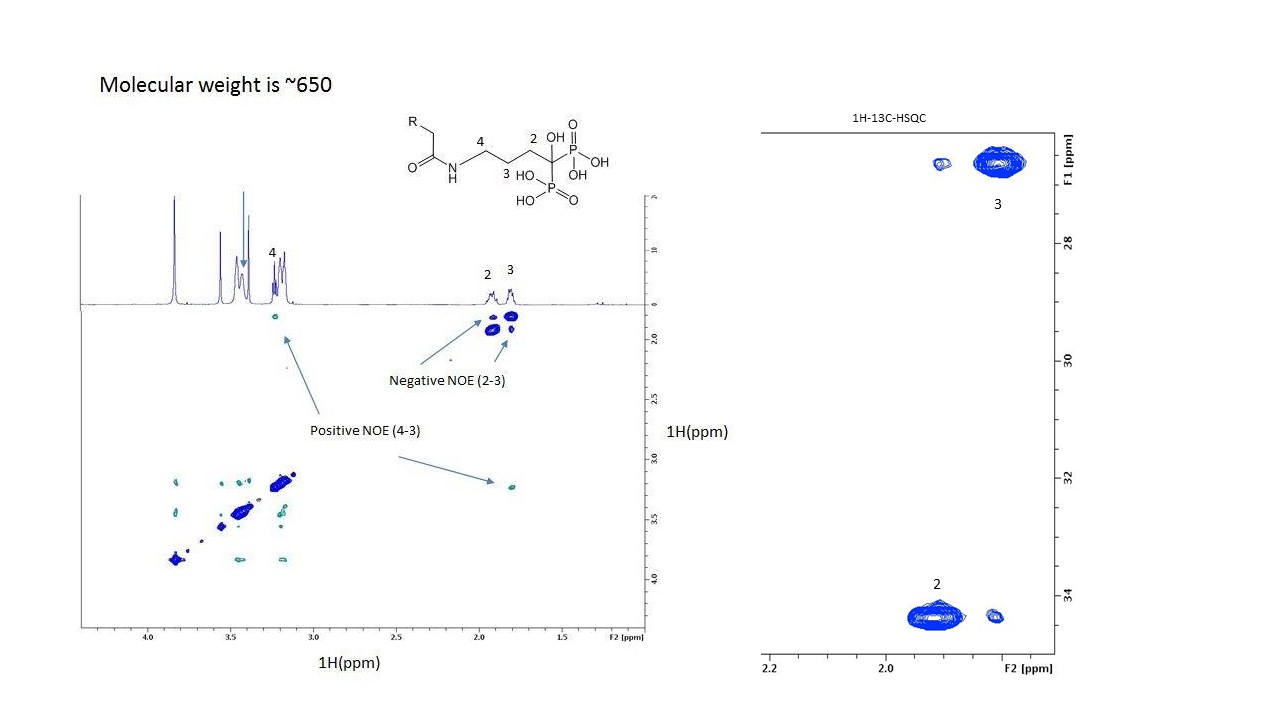
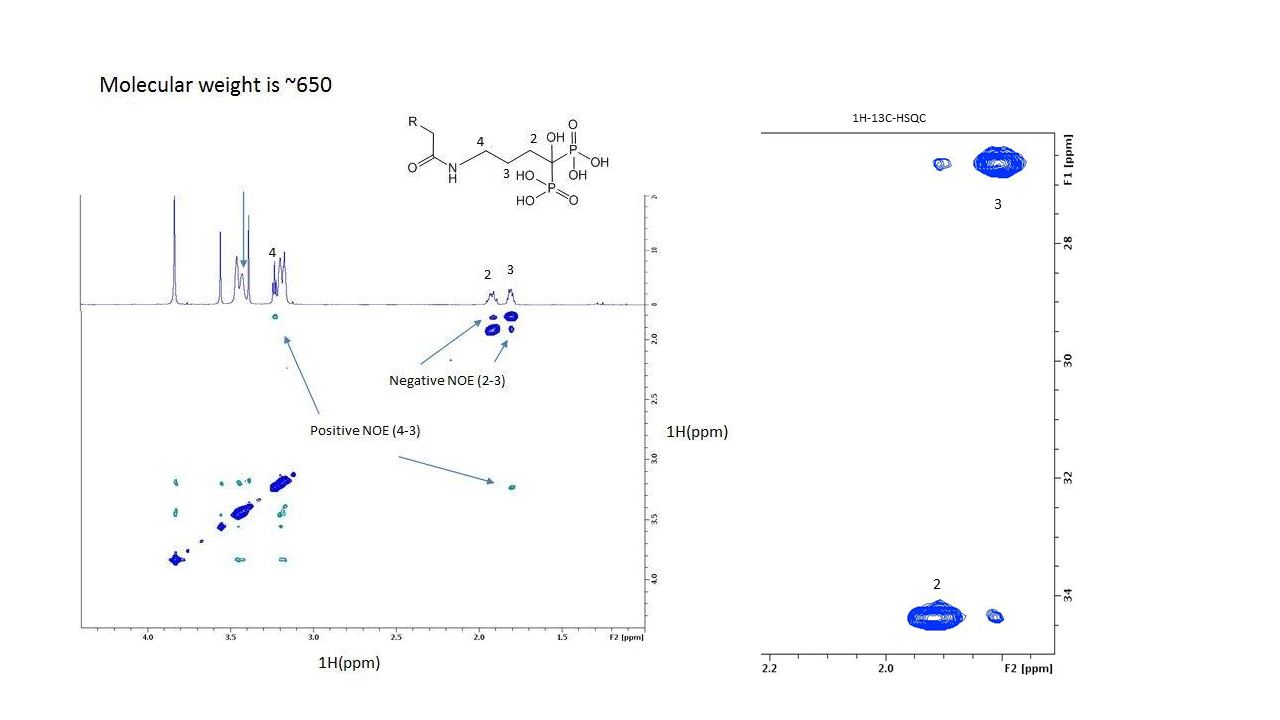
Here is another follow-up about the negative NOESY cross peaks.
Since last post, Karel Klika karkli_at_utu.fi<mailto:karkli_at_utu.fi> strongly suggested that it is possible due to minor peaks of proton 2 and 3 caused the negative NOESY cross peaks.
For the trouble shooting, I tried the ZQ filtered NOESY with shorter mixing time 250, 500 and 750 ms, the negative NOE are still there.
I then rerun the 1H-13C HSQC with 10 times more scans, and found some minor peaks (see the attached figure) which have the same chemical shifts with the negative NOE peaks.
This suggests that there are minor peaks from proton 2 and 3, and the chemical shifts of the minor peaks are coincident almost the same with major peaks of 3 and 2 protons, respectively.
I guess that should be the reason.
Thank you all for your suggestions and helps.
Best,
Weidong
From: Hu, Weidong
Sent: Thursday, February 21, 2019 12:08 PM
To: ammrl_at_ammrl.org
Subject: follow-up of Negative NOESY cross peaks from small molecule (less than 1000Da)
Dear Colleagues,
Thank you very much for addressing my concerns about the abnormal NOESY cross peaks on small molecule (less than 1000 Da). I should also listed other experimental conditions for acquiring this data in my original post. The solvent is D2O, and the pH is 7.56.
There are a lot of responses to my question. I am so thrilled and grateful to all of you, and this great group. Here is summary of possible causes from what I got:
1) It could be COSY peak due to strong couplings of A2B2 system.
Xianzhong Xu <xianzhong_at_tamu.edu<mailto:xianzhong_at_tamu.edu>> sent me a link illustrated similar pattern of cross peaks in NOESY of Ethylbezene. http://chem.ch.huji.ac.il/nmr/techniques/2d/noesy/noesy.html
2) It could be from zero quantum leakage. Suggested to use noesygpphzs to suppress the zero quantum.
3) It could be from aggregation or dimerization from the hydrogen bond of phosphoric acids, thus limit the rotation of C2-C3, and cause the negative cross peaks.
4) Chemical exchange/conformational exchange and spin diffusion.
At this moment, I favored the explanation that these two "negative" NOESY cross peaks should come from the overlaps of both NOESY and COSY. In the phase mode processed spectrum, the cross peaks only align well with diagonal peaks along indirect dimension, but not along direct dimension. Liermann, Dr. Johannes liermann_at_uni-mainz.de<mailto:liermann_at_uni-mainz.de> suggested to process with magnitude mode, then the cross peaks and diagonal peaks are aligned in both dimensions. This suggested there are some phase distortion caused peak offset because the overlap of inphase NOESY and antiphase COSY, but the phase distortion was removed from the magnitude process, and thus gone with the peak offset.
Thank you again for spending your precious time to help me on this issue.
The following are collection of responses in order of time received.
Kemper, Sebastian <sebastian.kemper_at_tu-berlin.de<mailto:sebastian.kemper_at_tu-berlin.de>>
Do you supress zero quantum coherrences? The both peaks are close and couple with each other. If you are not using a NOESY sequence with zero quantum supression, it might be worth to try it.
Anklin, Clemens Clemens.Anklin_at_bruker.com<mailto:Clemens.Anklin_at_bruker.com>
there is always the possibilty for "cosy" peaks to show up in NOESY experiments. There is a large coupling between those two spins.
With good resolution this could look like antiphase cosy peaks.
Dan Work work.danbearden_at_att.net<mailto:work.danbearden_at_att.net>
Looks like a great case of transferred NOE to me! From 4 to 3 to 2. This is accompanied by a sign change.
You can try a shorter mixing time or different solvent viscosity (temperature, for example). For mix -> 0 the transferred NOE should go to zero faster than the direct noe.
Martha Morton mmorton4_at_unl.edu<mailto:mmorton4_at_unl.edu>
It's the NH and POH exchanging.
Adolfo Botana Adolfo.Botana_at_jeoluk.com<mailto:Adolfo.Botana_at_jeoluk.com>
Their positions suggest that they are COSY crosspeaks, however, they seem to be in-phase rather than antiphase as we would expect from COSY peaks in NOESY. Maybe something is not correctly setup in the pulse sequence. I suggest recalibrating the pulses for the ZQF filtration or to use a pulse sequence with ZQF if you have not used one.
Juergen T Schulte schulte_at_binghamton.edu<mailto:schulte_at_binghamton.edu>
Indirect NOEs can be negative, i.e. 2a - 2b - 3a
Try a shorter mixing time to minimize the indirect component.
Eddy, Nicholas nicholas.eddy_at_uconn.edu<mailto:nicholas.eddy_at_uconn.edu>
Two thoughts for this:
1) rotational Overhauser effect; 1 sec mixing is awfully close to the rotational correlation times for some molecules.
2) spin diffusion.
In either case, try to shorten your mixing time to see if they decrease.
RonCrouch roncrouch1_at_mac.com<mailto:roncrouch1_at_mac.com>
Slow exchange about the amide C=O?
p.white p.white_at_science.ru.nl<mailto:p.white_at_science.ru.nl>
Are they strongly coupled? I sometimes see J coupling artifacts in HSQC spectra during the t1 evolution period...maybe a result of that?
Jerry Dallas jerryldallas_at_gmail.com<mailto:jerryldallas_at_gmail.com>
If the solvent is viscous like DMSO-d6 it will change the isotropic correlation time of the molecule to a slower value. This effect then renders negative noesy cross peaks ( e.g. same sign as diagonal).
This effect can also occur if the molecule is aggregating which effectively increases the molecular weight and changes the isotropic correlation time to a slower domain.
So a change of solvent and/or dilution is the best experimental approach.
Zhang, Weixing Weixing.Zhang_at_STJUDE.ORG<mailto:Weixing.Zhang_at_STJUDE.ORG>
Slow conformation change can also cause negative NOE.
Is there any barrier to rotation about the C-P bond?
I am curious to your question too.
Xianzhong Xu xianzhong_at_tamu.edu<mailto:xianzhong_at_tamu.edu>
I am guess that it might be due to the overlay of a dispersive(COSY) cross peak with an in-phase positive NOE peak:
http://chem.ch.huji.ac.il/nmr/techniques/2d/noesy/noesy.html
David Richardson David.Richardson_at_ucf.edu<mailto:David.Richardson_at_ucf.edu>
Doesn't look like zero-quantum J-coupling interference. Perhaps some sort of unexpected coupling due to hydrogen bonding with the OH? I don't really have an answer but please post a summary of the replies as I am curious what the correct answer might be.
Hongjun Zhou zhouhj_at_ucsb.edu<mailto:zhouhj_at_ucsb.edu>
It sounds to me your notion of positive and negative NOEs are opposite to the common way of specifying it. I am confused with how this is labeled in the spectrum and which ones you meant. I assume it's between 2-3.
I would say it's either from spin diffusion or it's COSY type peak, or mixed. Mixing time of 1 sec is on the long side that will enhance spin diffusion. I'd suggest trying NOESY with ~0.5 sec or shorter mixing time to minimize spin diffusion and COSY artifacts.
Liermann, Dr. Johannes liermann_at_uni-mainz.de<mailto:liermann_at_uni-mainz.de>
I think those are COSY-type artifacts since those protons are coupled. They sometimes appear for strong couplings in NOESY spectra because the pulse sequences are essentially the same. However, COSY artifacts normally give checkerboard-like antiphase multipletts like in the phase-sensitive COSY. Depending on your processing parameters, these may or may not seem like negative NOE peaks.
José R. Martínez jose.martinez53_at_upr.edu<mailto:jose.martinez53_at_upr.edu>
That could be a cosy correlation.
>From a lecture that I have in my records: "The cross-peaks between H1' and H2' are due to unfiltered COSY correlations that contaminate the NOESY spectrum. The "basic" NOESY experiment can be modified to filter out these cross-peaks, ..."
Looking the NOESY that you sent attached, it looks like a COSY correlation.
Craig Butts <Craig.Butts_at_bristol.ac.uk<mailto:Craig.Butts_at_bristol.ac.uk>>
I'll bet it's aggregating, as the phosphoric acids will encourage that in non-polar solvents.
Aggregating will cause slower tumbling and hence negative NOEs.
Nothing to worry about...
Zhu, Lingyang lingyang_at_illinois.edu<mailto:lingyang_at_illinois.edu>
This was very likely caused by the zero-quantum peak due to J-coupling between protons 3 and 4. You can try zero-quantum filtered NOESY to eliminate this artifact.
Richard SHOEMAKER rkshoemaker_at_msn.com<mailto:rkshoemaker_at_msn.com>
Since you clearly have considered this carefully, my idea might be way-off, but I may as well suggest it. You may already have eliminated this possibility through other experiments.
There could be possibilities for dynamic conformation exchange that could arise if your two multiplets labeled 2&3 might actually be "2&3" under one multiplet, and 2' & 3' under the other multiplet around 2.0 ppm.
If 2&3 are actually each shared between the two multiplets in question, then conformational dynamics could indeed cause exchange cross-peaks as observed in your NOESY spectrum, with 2 <->2' and 3 <-> 3'.
I am wondering what solvent you used because one could even envision a pseudo 6-ring-structure through intramolecular hydrogen-bonding between a phosphate and the amide group in which 2,2' and 3,3' are pseudo-axial and pseudo-equatorial, in which 2,3(pseudo-eq) are downfield and broader and 2',3' (pseudo-axial) would be upfield and narrower. This would be most likely observed in a solvent like CDCl3, which would drive such intramolecular hydrogen bonding. Changing to a solvent like DMSO-d6 might change the situation altogether.
I'm just trying to suggest crazy ideas based on things I've seen in the past, and this kind of thing happened to me not that long ago. In CDCl3 it was a pseudo-ring-structure with inequivalence and conformational dynamics, and in DMSO-d6 it was the pseudo-ring opened up and the spectrum became simpler.
jfxiang_at_iccas.ac.cn<mailto:jfxiang_at_iccas.ac.cn>
are you sure if the assignment of protons 2 and 3 were correct? Could you check them by hsqc? I am a little doubt about it.
Dave Russell dave95701_at_gmail.com<mailto:dave95701_at_gmail.com>
A bit of a long shot... was this spectrum symmetrized?
Anklin, Clemens <Clemens.Anklin_at_bruker.com<mailto:Clemens.Anklin_at_bruker.com>>
I think the situation is complicated here as you have a high order spin system A2B2 with couplings and NOE. The COSY cross peak would be distorted and the NOESY peak too. I cannot think of another reason right now why this should be positive cross peaks.
Kemper, Sebastian sebastian.kemper_at_tu-berlin.de<mailto:sebastian.kemper_at_tu-berlin.de>
No problem. For bruker spectrometer its noesygpphzs. During the mixing time there is not only a spoil gradient, there is also a 180degree adiabatic pulse with gradient (20ms smoothed chirp, 20% smoothing, ca. 10% gradient strength).
Akien, Geoffrey g.akien_at_lancaster.ac.uk<mailto:g.akien_at_lancaster.ac.uk>
I would think it highly likely that this is a zero-quantum artefact, which arises because the chemical shift difference between 2 and 3 is small compared to their J-coupling.
I guess you are using a version with some sort of zero-quantum suppression (noesygpphzs?) which does work well, but unfortunately there are limits for closely-separated peaks. If you zoom in to lower contour levels I would be surprised if you didn't see some tell-tale positive-negative type pattern, which is also a hallmark of this.
The only really reliable way of getting rid of them is to increasing the chemical shift differences (in Hz), so going to higher field, or maybe a solvent swap, although I'd be surprised if the latter one made enough difference to make it worthwhile.
André Dallmann andre.dallmann_at_chemie.hu-berlin.de<mailto:andre.dallmann_at_chemie.hu-berlin.de>
is it not just COSY cross-peaks as artifacts? This is what I observe quite regularly. The 3J coupling between 22 and 3 should be strong and thus the artifact as well.
DeRose, Eugene (NIH/NIEHS) [C] derose_at_niehs.nih.gov<mailto:derose_at_niehs.nih.gov>
We have seen this effect when the sample is aggregating. I this case, the sample behaves more like a larger biomolecule, giving rise to the negative cross-peaks. Changing the buffer conditions or adding detergent such has triton might break up the aggregates.
Richard SHOEMAKER rkshoemaker_at_msn.com<mailto:rkshoemaker_at_msn.com>
I presumed you would have additional data to rule out my suggestion.
I would expect COSY peaks to appear as antiphase.
The dimer idea is another good one.
Best of luck on this interesting puzzle. I miss the opportunity to work on these.
jerryldallas jerryldallas_at_gmail.com<mailto:jerryldallas_at_gmail.com>
If the effective MW was 1300 noe would be smaller but still positive. If it reached 2000 the noe would approach zero.
If the molecule is dimerizing then intermolecular noe cross peaks will be negative.
The cosy cross peaks will have */- antiphase phase in a phase sensitive experiment. They can be suppressed by randomizing the timing of the 180 pulse in the.middle of the mixing period. The old approach involved adding a variable incrementing + delta delay before the 180 and a similar delay -delta after the 180. The initial + delta is zero and the initial -delta is 5 or 10 % of mixing time. The delta values increment(+delta) and decrement(-delta) with each increment of T1 during the 2D experiment. The noesy cross peaks are unaffected by the small progression of the 180 however the cosy cross peaks are smeared into the noise. Ralph Hurd promoted this concept for small molecules in mid ~1985.
Bruker spectrometers had a parameter " r" which could be appended to the mixing delay. It would randomize this delay and produce a similar effect. The downside of these approaches is some additional t1 noise.
The guys who pursue larger molecules with negative noe values tend not to worry about cosy cross peaks in noesy. The cosy peaks are antiphase and the broad lines tend to cause self cancellation.
As I recall, the best noesy2D with gradients was published by Wagner in the 90's. But I dont recall if he addressed suppression of cosy peaks.
During my days running lots of small molecules I just tended to recognize cosy cross peaks in noesy data and I learned to work around the issue.
jn peng jnpeng_at_yahoo.com<mailto:jnpeng_at_yahoo.com>
It's not unusual to see residual COSY signal (negative) in NOESY spectrum.
Liermann, Dr. Johannes liermann_at_uni-mainz.de<mailto:liermann_at_uni-mainz.de>
That sounds very reasonable. If the offset results from subtractive overlap between an antiphase COSY signal and a NOESY signal it might go away if you try processing the spectrum in magnitude mode?
g-sukenick_at_ski.mskcc.org<mailto:g-sukenick_at_ski.mskcc.org>
Generally those peaks occur due to solvent exchange or movement constraints such as rotamers which change the correlation time.
There was a paper a while ago that used the sign of NOE to demonstrate rotamers (instead of heating the sample). Maybe H bonding between the oxygen on the phosphate and #2 proton or steric hinderance going on?
Zhu, Lingyang <lingyang_at_illinois.edu<mailto:lingyang_at_illinois.edu>>
I'm still using the VNMRJ software (We have only one Bruker used in automation mode), and the zero-quantum filtered NOESY is a standard experiment in Varian. I searched the Bruker pulse sequence library, and the experiment in Bruker uses Thrippleton and Keeler's method is noesygpphzs. You may give a try.
Andre Dallmann andre.dallmann_at_chemie.hu-berlin.de<mailto:andre.dallmann_at_chemie.hu-berlin.de>
In my experience the normal phase could be the result of the very long mixing time, though...
jerryldallas jerryldallas_at_gmail.com<mailto:jerryldallas_at_gmail.com>
I understand the cost issue. It's most cost effective to compare cosy & noesy spectra on a light table or window. I often just viewed slices on the display screen to discriminate between the two types. The antiphase behavior of cosy cross peaks is easy to see while noesy peaks are purely up or down.
It was nice to review these issues. I've been retired for 5 yrs.
From: Hu, Weidong
Sent: Tuesday, February 19, 2019 3:05 PM
To: 'ammrl_at_ammrl.org' <ammrl_at_ammrl.org<mailto:ammrl_at_ammrl.org>>
Subject: Negative NOESY cross peaks from small molecule (less than 1000Da)
Dear colleagues,
Typically, the NOESY cross peaks from small molecule (less than 1000 Da) have opposite sign relative to diagonal peaks, so called positive cross peaks. But I observed negative cross peaks from a molecule about 650 Da (see the attached spectrum). It cannot be due to exchange since these protons are not exchangeable. Does anyone have explanation for this observation. The NOESY mixing time was set to 1 sec and temperature is 40C.
Thanks in advance.
Weidong
Dr. Weidong Hu
NMR Facility Manager
Department of Molecular Imaging and Therapy
Beckman Research Institute
1450 E. Duarte Rd., Duarte, CA 91010
Tel: 626 256 4673, Ext: 63416
Fax: 626 301 8186
------------------------------------------------------------
-SECURITY/CONFIDENTIALITY WARNING-
This message and any attachments are intended solely for the individual or entity to which they are addressed. This communication may contain information that is privileged, confidential, or exempt from disclosure under applicable law (e.g., personal health information, research data, financial information). Because this e-mail has been sent without encryption, individuals other than the intended recipient may be able to view the information, forward it to others or tamper with the information without the knowledge or consent of the sender. If you are not the intended recipient, or the employee or person responsible for delivering the message to the intended recipient, any dissemination, distribution or copying of the communication is strictly prohibited. If you received the communication in error, please notify the sender immediately by replying to this message and deleting the message and any accompanying files from your system. If, due to the security risks, you do not wish to receive further communications via e-mail, please reply to this message and inform the sender that you do not wish to receive further e-mail from the sender. (LCP301)
------------------------------------------------------------
(image/jpeg attachment: Negative_NOE.jpg)
(image/png attachment: negative_NOE.png)