Date: Thu, 5 Mar 2015 14:58:19 +0000
Hi all,
I need some advice. I have a professor regularly doing INADEQUATE experiments on natural products. We use a shegemi tube and have been getting pretty good data, but obviously the concentrations are low and the experiments long. He is a solid-state spectrocopist so 6-7 day experiments are not a big deal to him, but on my shared liquids instruments it has become an issue. We are having a dispute about using a lengthy d1 and making the experiment much longer than I think is necessary. We did a C13 T1 measurement on the most recent compound and found the longest T1 to be about 12 seconds, so he wants to run with a d1 of nearly 30 seconds. I think this is utterly insane, especially for an INADEQUATE. I tried to explain about the steady-state gradient pulses (see the attached picture - hopefully screenshots make it through the filters) that precede every scan in most of the modern advanced pulse sequences and that they exclude the need for a long d1 even when some of the spins have a long T1. He didn't buy my explanation and still has his students run 6-7 day experiments; I am about to restrict his access to our 500 and make him use the 300 exclusively. I understand the steady-state gradient pulses (apparently called crusher gradients, as I learned in my reading yesterday) kill any remaining transverse magnetization, but I am unable to explain how. Does it actually return the system to the equivalent of thermal equilibrium? Even if not, I imagine any signal loss would be more than compensated for by running 10+ scans with a short d1 in the same amount of time he runs 1 scan with a long d1. Can anyone please help clarify this for me so I can better explain to him it is unnecessary. Also, if I am completely wrong and a long d1 is still needed please tell me that too. I can understand if it were, perhaps, a DOSY or some other quantitative experiment, but not on your general 2D experiments.
Thanks in advance,
David
David Richardson, Ph.D.
NMR Instrumentation Specialist
Chemistry Department
University of Central Florida
david.richardson_at_ucf.edu<mailto:david.richardson_at_ucf.edu>
407-823-2961
http://chemistry.cos.ucf.edu/nmr/
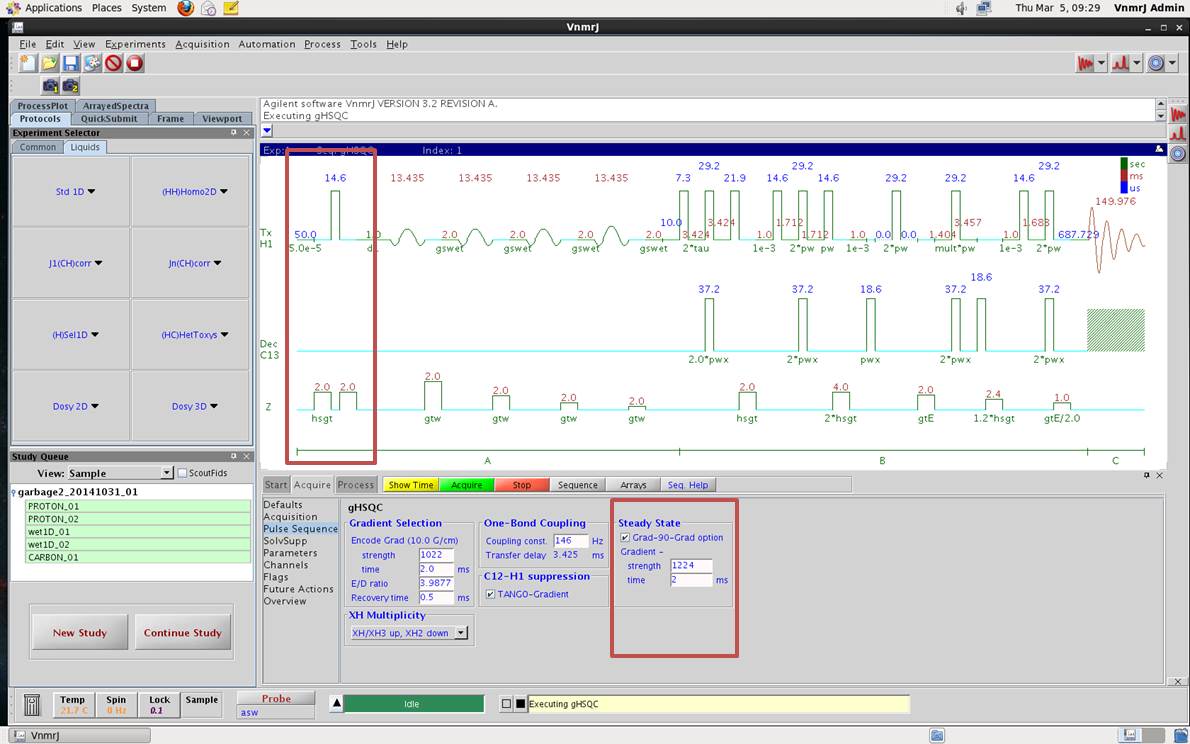
(image/jpeg attachment: dps_screenshot.jpg)