Date: Mon, 4 Jan 2021 17:55:49 +0000
Hello again,
I really have to thank all people, who made suggestions to understand this issue.
After presenting the first summary i got some more helpful input from Charles DeBrosse,
Robin Stein and Abil Aliev.
The solution is rather simple, but I really wasn't aware of the stereochemical background all my life.
I discussed with a lot of people and fortunately (as excuse for my lack of base knowledge)
nearly nobody was aware of the true solution. Even in some textbooks there are wrong explanations,
assuming restricted rotations, which is not necessary at all.
A good explanation is available from Robert M. Silverstein and Robert T. LaLonde in
J. Chem. Educ. 57(1980), 343 - 344
(Chemical Shift equivalence and Magnetic Equivalence in Conformationally Mobile Molecules).
Because I assume, some of the participants of this list are not familiar with this particular
question of magnetic non equivalence (like me), please let me try to provide an explanation.
The spinsystem of all compounds of the general molecular formula X-CH2-CH2-Y is not of the type A2X2
(or A2B2) but AA'XX' (or AA'BB'). This is a general rule without exception. Sometimes the nonequivalence is
not visible, sometimes the effect if rather impressive. One nice example is
2-chloroethanol in D2O (Biological Magnetic Resonance Data Bank)
https://bmrb.io/metabolomics/mol_summary/show_data.php?id=bmse000360
another one is 1-bromo-2-chloro-ethane
https://spectrabase.com/spectrum/zRoqNITnsB
In my example, the only role of C-13 was to change a compound of the type
X-CH2-CH2-X into X-CH2-CH2-Y, nothing else.
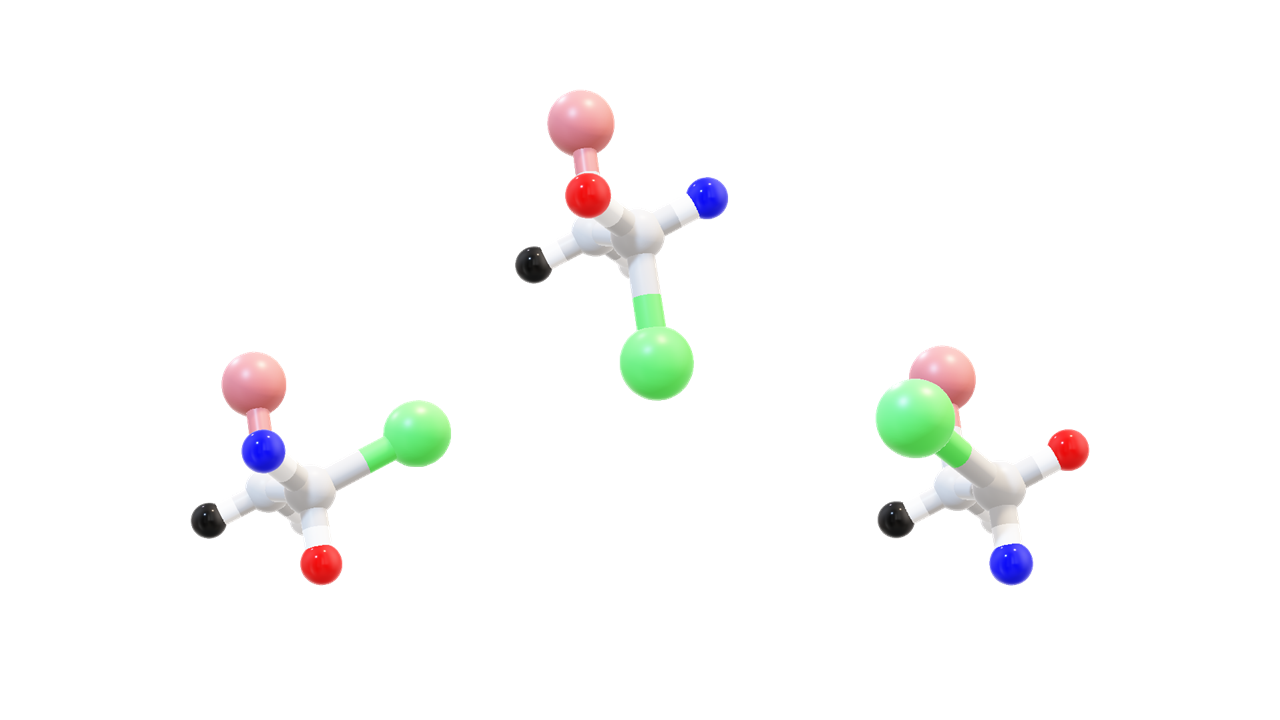
And now let me try an explanation using my words. I am not too happy with my own graphics.
To provide a better one, I have to learn Blender. That's an impressive piece of
Software, but the learning curve is really steep. Anyway, let's try with the low quality models.
The pink and green balls represent X and Y. The black/grey and the blue/red pairs of hydrogen
are chemically equivalent. The starting point could be the two lower rotamers. Both behave like
image and mirror image. The statistical probability of both rotamers is the same. The red hydrogen
mirrors to the blue one and vice versa. They are chemically equivalent as already said above.
Bot now let us inspect the vicinal coupling constants between the hydrogen pairs black/blue and
black/red It is sufficient to look at the dihedral angles.
In the left side rotamer we have
black/blue - 60 degree
black/red - 60 degree
In the right side rotamer we have
black/blue - 60 degree
black - red - 180 degree
If we average over both rotamers the vicinal coupling constants black/blue and black/red are *not identical*
If we take the upper rotamer into account we observe
black/blue - 180 degree
black/red - 60 degree
If we average over all three rotamers both coupling constants become the same
*assuming the statistical probabilities of all three rotamers are identical.*
As soon, there is a difference in this statistic probability there is no longer
a perfect averaging of the black/blue and black/red coupling constant, which means
they are magnetically non equivalent.
Why "intermediate summary"?
Novruzh Akhmedov made a very beautiful simulation of the proton spin system in 1,3-Dichloro-propane.
Many, many thanks. You might see this as X-CH2-CH2-Y type compound as well with X -- -Cl and Y- CH2Cl.
Actually I am providing a summary of this nice example, but that's really Challenging (and time consuming).
You know: Blender ... :-)
I hope, my description in combination with the lack of english knowledge was not too bad.
Greetings
Rainer
(image/png attachment: 3D-Test.png)