Date: Wed, 14 Dec 2022 17:18:31 -0800
Dear Wizards
First of all, I am so immensely thankful to all of you who have
taken the trouble to address an obscure problem such as the 2H based
Topshim failure in my 20 years old instrument(s). My gratitude from the
bottom of my heart. So many of you have reached out to me offering
generously the spare 2H-HPPR slice that is at your disposal.
I did reply to the individual mails about the questions/points raised
but I thought I will add the following points/questions directly to this
fantastic group at large, for the educational benefit of us, since the
problem does seem to hold some absorbing interest in relation to the inner
workings of the spectrometer hardware. Speaking for myself,
notwithstanding the exasperation in having two (may be more !) instruments
that do not perform up to the expectations, troubleshooting this has been a
learning experience for me.
The majority of you suggested that the problem I face is in the transmitter
side of things rather than the receiver path, as I have hypothesized. In
this regard :
- I mentioned that I get a p90 pulse for 2H of about 110 us at -6 dB
setting for my 20W 2H-TX board. Most of you agreed that this is not a
bad number and it does look right.
- I went on and measured the actual power delivered with an (Attenuator
+ Scope) setup. With one of the two instruments I have mentioned, I am
getting about 24 W for the lowest attenuator setting (-6 dB). This is in
line with the '20W' capability advertised for 2H-TX. But, I do see an
insertion of loss of 4 dB across the HPPR-2H slice alone. At the probe,
this 25 W becomes 7.94 W.
- Now, this 7.9 W in itself is not necessarily that bad. I have an
Avance-III system without a dedicated 20W 2H amplifier and it puts out just
5 W. As I will show below, the Topshim works flawlessly in that system.
So, IMHO, the transmit side of things alone don't explain this failure,
what with the established fact that the 2H pulse width of 110 us is
reasonable.
- Now, I have a question for the group in relation to the role of
transmitter path in this problem. I will ask the naive NMR 101 question
to myself : even if the p90 pulse width is larger than expected (say,
because the 2H amplifier puts out less power), why should that affect the
sensitivity of a 'single pulse like' gradient echo experiment that is used
for generating the field map ? As long as 'getprosol' loads the correct
p90 value for 2H, it should not have an effect on the echo amplitude, is
it not ?
- To satiate my curiosity (or to brush up my rusty memory), I went to
Fukushima and Roeder (a.k.a. Nuts and Bolts). I came away with the
understanding that the effective magnetization M that can be detected as a
function of (gamma B1) goes down slowly and only for large resonance
offsets. In other words, even for a weak 90 pulse, as long as I am 'on'
resonance, the effective magnetization detected is not that different from
what we would measure with a narrower 90 pulse. In the scenario we discuss
here, this is certainly true i.e. either the Topshim program or the
'gradshim1d2h' does set the O1P to be 'on' resonance and so the
amplitude of Magnetization detected in the XY plane doesn't explain the low
sensitivity of the gradient echo profile, don't you think ?
- Given the above and my p90 being something reasonable, I am not sure
if the transmitter side of things still explain the problems I am facing.
Now I will take the liberty to add a couple of images here, to complete the
picture.
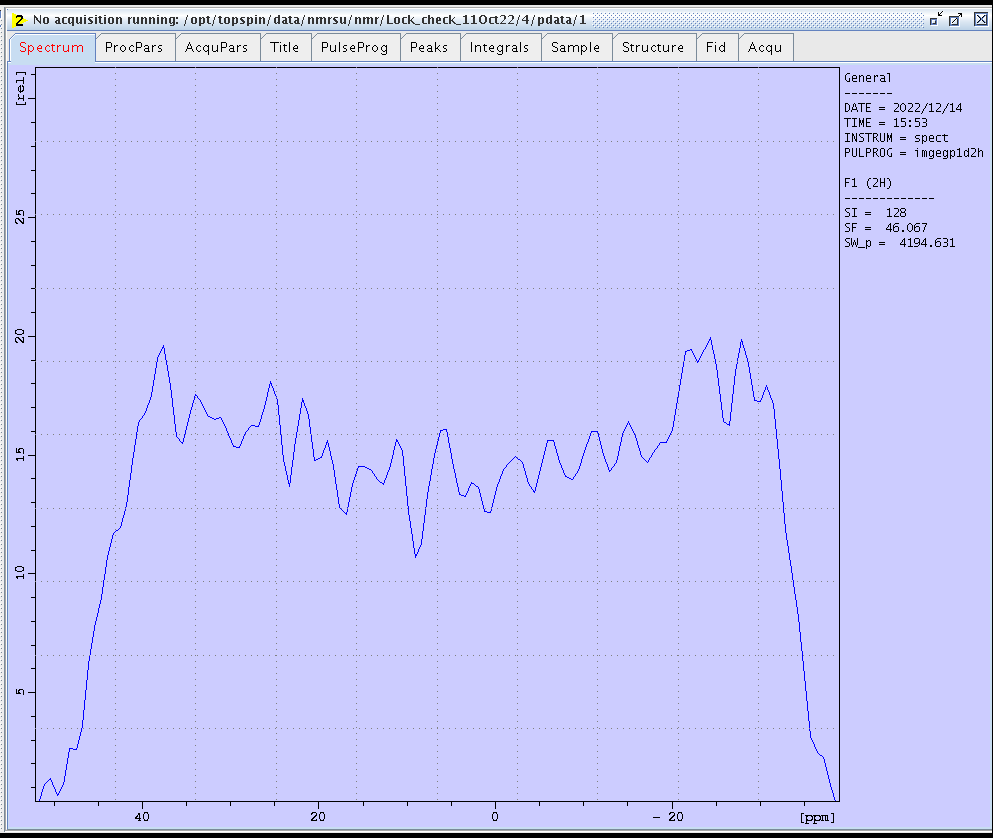
- Here is my noisy 2H gradient echo profile I recorded on my 300. I did
this using the parameter set 'gradshim1d2h' (I couldn't generate a profile
using 'topshim map' since it is failing due to poor S/N:
[image: image.png]
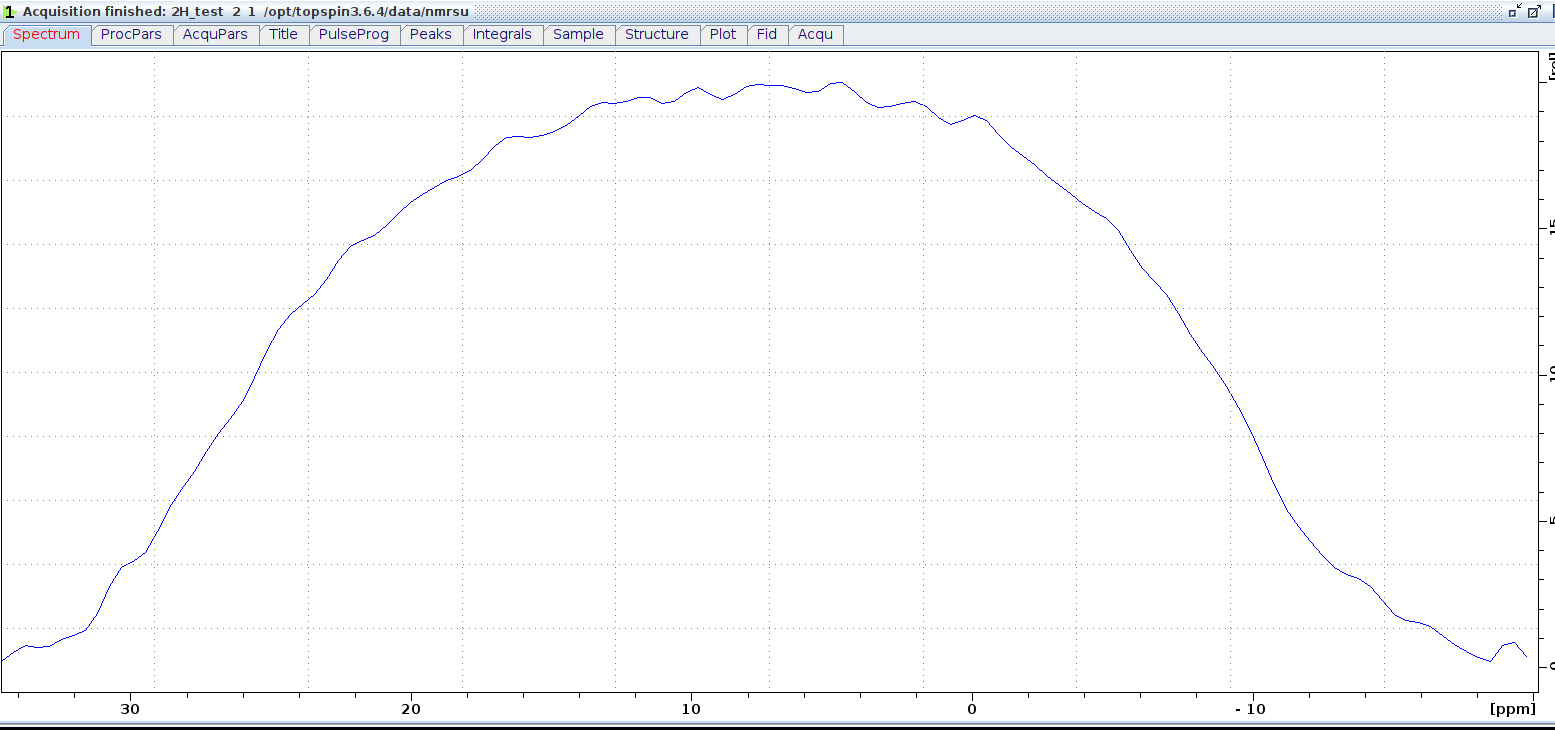
- *In contrast : *Here is the 2H gradient echo profile that I recorded
on my more modern Avance-III 500 spectrometer, which puts out only 4.7 W at
the probe for 2H (this is for the same solvent CDCl3). The p90 pulse width
is approx. 300 us for this instrument. The probe with this instrument is
TXO (and hence the profile shape difference). This is the result of
'gradshim1d2h' parameter set:
[image: image.png]
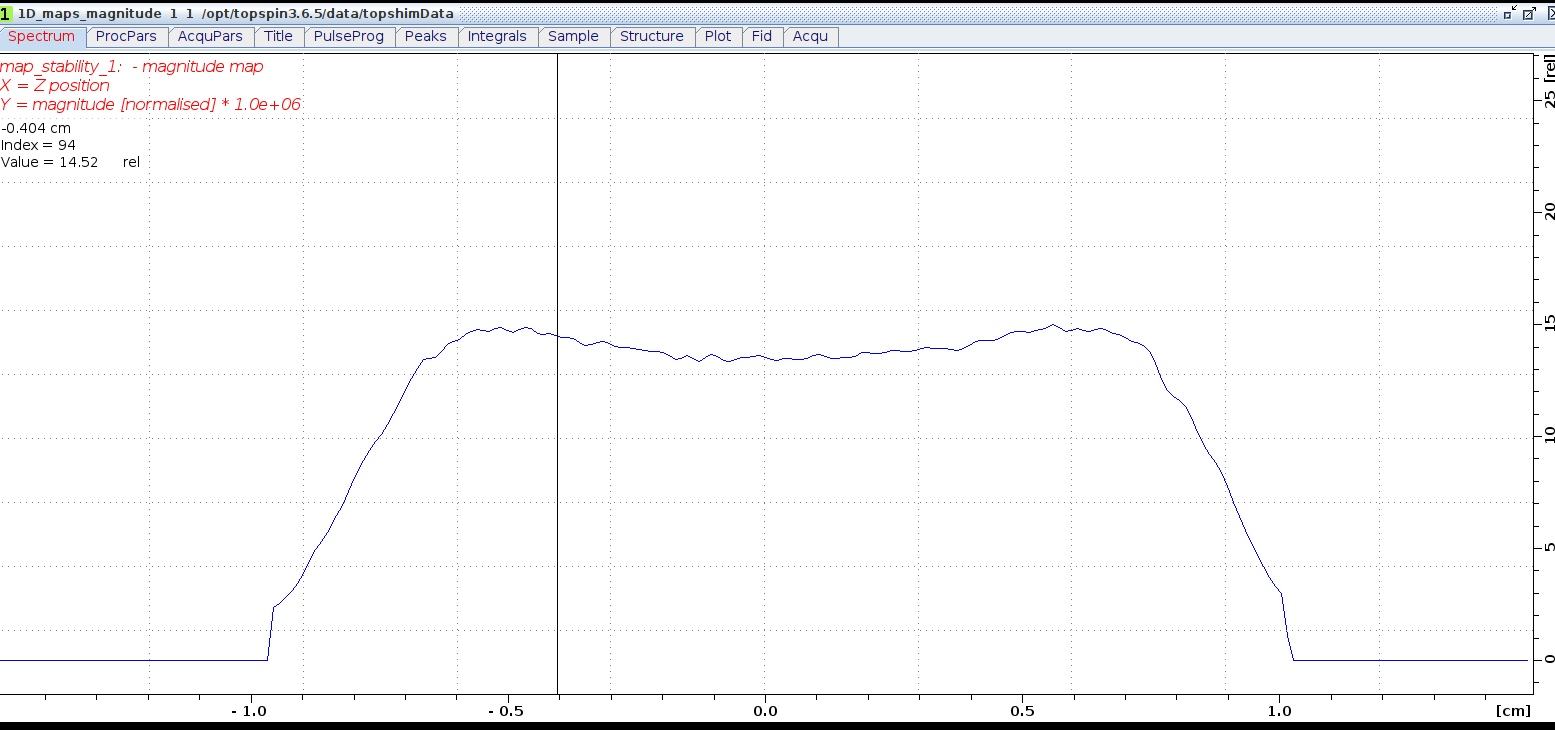
- with this instrument, I could record the field magnitude map from
within Topshim. Here is that profile :
[image: image.png]
*Final question(s) : *Based on these data
- do you still think that the transmitter side of things is what is
causing problems for me ?
- Or, are you more inclined to doubt the HPPR-2H to be the culprit ? I
did consider RX22 as a common point of failure, but 1H experiments for
known samples give the expected RG values. What more, my Topshim with 1H
solvent such as H2O+D2O performs great and gives a great gradient echo
profile. So, RX22 cannot be the problem *per se.*
- I am convinced that the 4 to 5 dB insertion loss through the 2H preamp
slice is excessive, though this is still in the transmitter path.
Nevertheless, do you think this figure is something of a smoking gun for
the receive path problems as well ?
With due apologies for this long mail (again !) and thank you so much for
sparing your time and thoughts generously to address my questions.
I am indebted forever to this awesome group.
Best Regards
Rajan
On Fri, Dec 9, 2022 at 11:26 AM Rajan K Paranji <rajanp_at_uw.edu> wrote:
> Dear Spinners
> I have two ageing 300 MHz Bruker Avance MicroBay systems (AV-I) that
> have served us rather well over twenty years and are still soldering on.
> I don't see any $$ in the foreseeable future to replace them and so I have
> to keep these as happy as I can. These systems are run using Topspin 2.1
> PL10 and the software cannot be upgraded for this vintage of hardware.
> They have developed the unique problem that Topshim for any of 2H based
> solvent pretty much fails with the error codes of Raw Check: no signal at
> all or Signal to Noise too low.
> Even in the cases where the S/N of the lock signal is decent such as
> that of DMSO or C6D6, Topshim says it has completed successfully, but the
> improvement is by a factor of 1.0 i.e. nothing in the form of B0
> homogeneity improvement is made.
>
> The same system does fantastic when I shim on a H2O+D2O or
> 1H-Acetonitrile solvent i.e. when I use the 1H nucleus to generate the
> gradient echo and do the shimming.
>
> I have spent quite a bit of time following every possible lead (I have
> taken one of the two systems offline for the past two weeks; the other
> system is being used with touching up the shims by hand). Probeheads are
> ruled out (different ones are tried) as are the basic hardware related to
> the shims such as shim current boards and the shim stack. RX22 board can't
> be blamed as well since the whole operation with 1H passes with flying
> colors. RX22 is agnostic to the nuclei being pulsed since it does its
> amplification at the Local Oscillator frequency of 22 MHz.
> By sheer process of elimination, the only culprit I can think of is
> the 2H preamplifier slice. Here is where the reasoning becomes all the
> more challenging. The likelihood of two systems failing exactly the same
> way with two identical hardware components becomes rather low when we
> multiply the individual probabilities. Nevertheless, the fact that these
> two instruments are identical twins (with consecutive serial numbers !) and
> are of the same age mitigates the 'unlikelihood' to an extent.
>
> I am coming to you with my Hat in Hand and that is the motivation
> behind this long winded story above. Do any of you have an HPPR/1 2H
> preamplifier slice for a 300 MHz stashed away that you can donate or let me
> borrow for testing my hypothesis i.e. 2H preamplifier failure is leading to
> my poor/failed Topshim 2H performance ?
>
> Thank you for sparing your precious time.
>
> Best Regards as always
>
> Rajan
>
> --
>
> ____________________________________
>
> Rajan K Paranji, Ph.D.NMR Facility Manager
> *Department of Chemistry**Room 65, Bagley Hall*
> University of WashingtonSeattle, WA 98195
> phone : 206 685 2581 fax: 206 685 8665email: rajanp_at_uw.edu
> ____________________________________________________________________
>
>
>
>
>
--
____________________________________
Rajan K Paranji, Ph.D.NMR Facility Manager
*Department of Chemistry**Room 65, Bagley Hall*
University of WashingtonSeattle, WA 98195
phone : 206 685 2581 fax: 206 685 8665email: rajanp_at_uw.edu
____________________________________________________________________
(image/png attachment: image.png)
(image/png attachment: 02-image.png)
(image/png attachment: 03-image.png)