Date: Thu, 31 Aug 2023 16:49:54 +0000
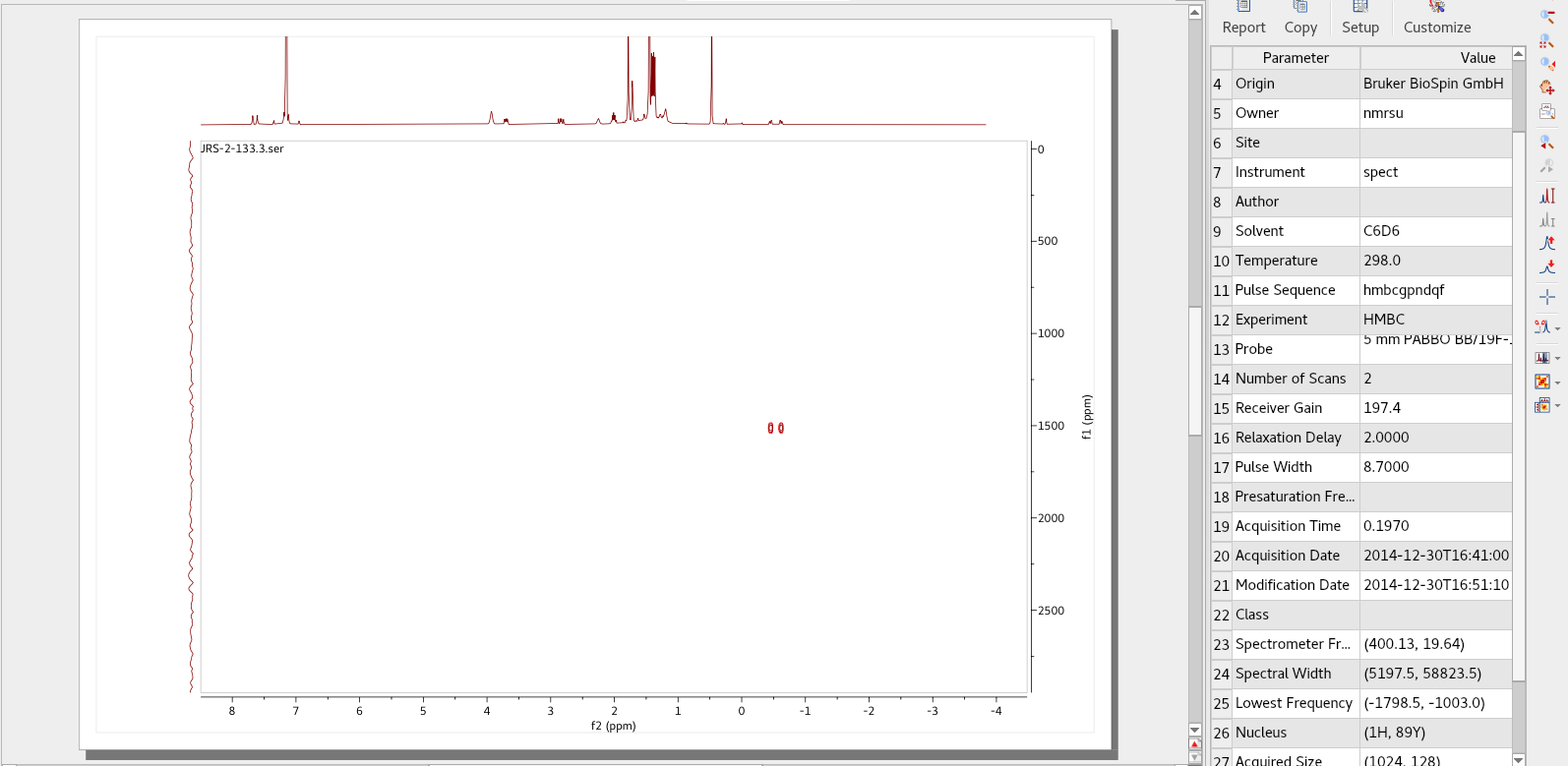
1H-89Y HMBC is pretty straightforward and 89Y sits just above 109Ag which is
the nominal low frequency limit of many Bruker broadband probes. Setting it
up from scratch, you can guess the length of a 89Y pulse by extrapolating
from anything which is calibrated nearby assuming the pulse voltage is constant
and then the pulse just scales with the gyromagnetic ratio. The simplest
version of an HMBC is pretty forgiving (starting from the 1H-15N parameters
with no 1 bond couplings suppressed, no filters on the size of the J). That
pulse estimate is enough to get started. You can refine the parameters by
running arrays of just the first block of the HMBC. If you don't know where
they X signal is (a problem especially for something like 195Pt), you can
find it quickly with an array of X nucleus carrier frequencies. With the
X signal frequency known, the low gamma pulse width can be calibrated with
an array. Likewise, if the 1H-X J coupling is not resolved in the 1H, you
can find the value that gives the most signal.
Our experience here is limited to a few 89Y organometallics and the 89Y shifts
calculated by absolute referencing were bigger than we expected, but that was
the outcome. We never saw any 89Y signals by direct observation, very long
T1's and low concentration likely weren't helping.
The same approach has worked for some really low gamma nuclei. We have a newer
type Bruker iProbe that is rated to reach 109Ag, and that is the lowest frequency
it will reach. However we have a previous generation Bruker probe that will go
to lower frequencies. It will tune but not quite match the 12.5 MHz frequency
for 103Rh, close enough for HMBC. I got an HMBC signal from Rh(acac)3 even
though there is no resolved Rh multiple bond coupling in the 1H spectrum. To
get this going, we got some valuable help from Brian Andrew at Bruker with
putting firmware entries for these wacky nuclei into that probe.
________________________________
> From: main_at_ammrl.groups.io <main_at_ammrl.groups.io> on behalf of Craig Grimmer <craig.grimmer_at_gmail.com>
> Sent: Thursday, August 31, 2023 5:29 AM
> To: main_at_ammrl.groups.io <main_at_ammrl.groups.io>
> Subject: Re: [AMMRL] Y89 measurement
Good afternoon Stephen
For 89Y (transmitter frequency 24.5013454) on a 5 mm broadband probe on a "500"
magnet, I use a 3 M solution of Y(NO3)3.6H2O and I get a reasonable signal
from 4 scans (transients) with d1 = 720 seconds with pw = 18 us at 150 W.
I've not measured the T1 of this sample but 720 seconds seemed a reasonable
figure based on the information in Brevard & Granger's book that reads "T1
typical value (s): > 50"). If you're struggling to find a signal from a
multi-molar solution, set a wide sweep width to start with, ~1000 ppm.
Kind regards,
Craig.
-=-=-=-=-=-=-=-=-=-=-=-
Groups.io Links: You receive all messages sent to this group.
View/Reply Online (#501): https://urldefense.com/v3/__https://ammrl.groups.=
io/g/main/message/501__;!!PvDODwlR4mBZyAb0!Wp-zWM5URcdjMfcMTP_t2P0AHWdcGIKS=
tmNlrAXBSILyWK5w_dQoemnzQHlNJQ3Ef3x9VJ4MRST_suMA9Q$
Mute This Topic: https://urldefense.com/v3/__https://groups.io/mt/101067099=
/7559972__;!!PvDODwlR4mBZyAb0!Wp-zWM5URcdjMfcMTP_t2P0AHWdcGIKStmNlrAXBSILyW=
K5w_dQoemnzQHlNJQ3Ef3x9VJ4MRST8Mm7GMw$
Group Owner: main+owner_at_ammrl.groups.io
-=-=-=-=-=-=-=-=-=-=-=-
(image/png attachment: Screenshot_from_2023-08-31_09-47-14.png)